ajeetraina777/sbx-kits-michelangelo
Docker Sandboxes mixin that runs Uber's Michelangelo ML platform locally via k3d
388
ajeetraina777/sbx-kits-michelangelo repository overview
Installs the `michelangelo` SDK/CLI (the `ma` client) into an agent sandbox and wires it to a Michelangelo ML platform running OUTSIDE the microVM (on your host's Docker Desktop, or a remote cluster). Credential-free and lightweight: the platform runs elsewhere, the sandbox holds only the client. Mirrors the Grafana / Ollama "sandbox the agent, talk to a host service" pattern.
pypi.org
files.pythonhosted.org
host.docker.internal:15566
host.docker.internal:9091
Apply this mixin to a sandbox
sbx run <agent> --kit docker.io/ajeetraina777/sbx-kits-michelangelo:latestMake sure you have docker sbx installed
Run the following command to install sbx on your machine.
brew install docker/tap/sbxwinget install Docker.sbxsbx kit for Michelangelo
Quickstart
Layer this client kit onto any agent - it installs the ma client and wires it to a Michelangelo running
outside the sandbox (bring one up on your host: Run Michelangelo on the host):
sbx run --kit docker.io/ajeetraina777/sbx-kits-michelangelo:latest claude
Inside the sandbox the ma client is on PATH, pointed at $MACTL_ADDRESS (default
host.docker.internal:15566). Swap claude for codex, gemini, or shell; from a local clone use
--kit ./ instead of the image.
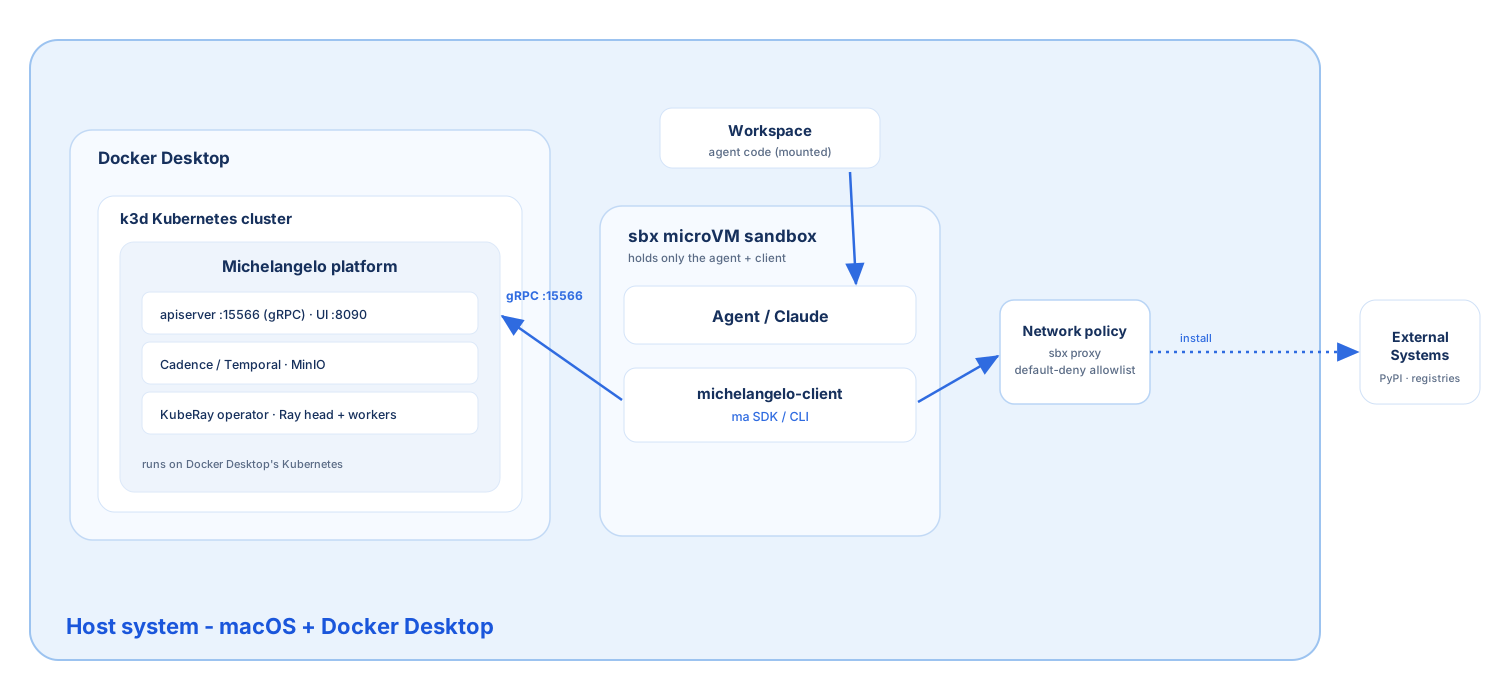
Run Uber's Michelangelo ML platform on your host's Docker Desktop, and use a Docker Sandbox microVM as an isolated coding agent that talks to it - the architecture above.
How it fits together
- Michelangelo runs on the host. Docker Desktop provides the Docker daemon; Michelangelo's
ma sandbox create stands up a local k3d Kubernetes cluster that hosts the whole platform - apiserver (:15566), dashboard (:8090), workflow engine (Cadence/Temporal), object storage (MinIO) and a KubeRay compute cluster. - The sandbox holds only the client. This kit installs the
michelangeloSDK/CLI (ma) inside an sbx microVM and points it at the platform over plaintext gRPC. Credential-free and lightweight - nothing heavy runs in the sandbox, and the allowlist is just PyPI plus the backend host.
Run Michelangelo on the host
Prerequisites are all host-side (per the upstream sandbox setup):
- Docker Desktop (or Colima / Docker Engine) - a running Docker daemon.
- kubectl · k3d · Helm · Python 3.11 or 3.12 · Poetry -
brew install kubectl k3d helm [email protected] poetry(Python 3.13+ fails, so pin[email protected].)
Then build the ma CLI and bring the platform up on Docker Desktop:
git clone https://github.com/michelangelo-ai/michelangelo.git ~/michelangelo
cd ~/michelangelo/python && poetry env use python3.12 && poetry install   # builds the `ma` CLI
export PATH="$PWD/.venv/bin:$PATH"
cd ~/michelangelo && bash scripts/kuberay/build-kuberay-images.sh          # local KubeRay images
ma sandbox create            # k3d cluster + platform on Docker Desktop (30-60 min first run)
ma sandbox demo pipeline     # smoke test → dashboard at http://localhost:8090
ma sandbox create wants roughly the upstream minimums - 4 vCPU / 8 GB RAM / 60 GB disk - so give
Docker Desktop enough resources (Settings → Resources). Lifecycle: ma sandbox sync (redeploy),
ma sandbox stop|start, ma sandbox delete. The web UIs are published to localhost: dashboard :8090,
Grafana :3000, Prometheus :9092, Cadence Web :8088; the gRPC API is :15566.
The client kit
The kit sets these env overrides (read by mactl), so there is no config file to edit:
MACTL_ADDRESS- apiserver gRPC endpoint (defaulthost.docker.internal:15566)MACTL_USE_TLS=false- the OSS apiserver speaks plaintext gRPC (no cert/SAN)AWS_ENDPOINT_URL/AWS_ACCESS_KEY_ID/AWS_SECRET_ACCESS_KEY- MinIO (minioadmin/minioadmin)
Egress is just pypi.org + files.pythonhosted.org (to install the client) and the host.docker.internal
ports - 4 entries, no registries or chart repos.
Caveat: the client needs a routable backend the sbx proxy can forward to. A Michelangelo on the same macOS + Docker Desktop as the sandbox is not routable from it - the microVM cannot reach the host's loopback-bound ports. Point
MACTL_ADDRESSat a remote/routable cluster for a working round-trip.
Publish the kit
./scripts/push-kit.sh                 # validates, then pushes :latest to Docker Hub
TAG=v1 ./scripts/push-kit.sh          # pushes :v1
The push script runs sbx kit validate before sbx kit push, so a bad spec fails before anything reaches
the registry. CI (.github/workflows/publish.yaml) does the same on every
push to main that touches the spec.